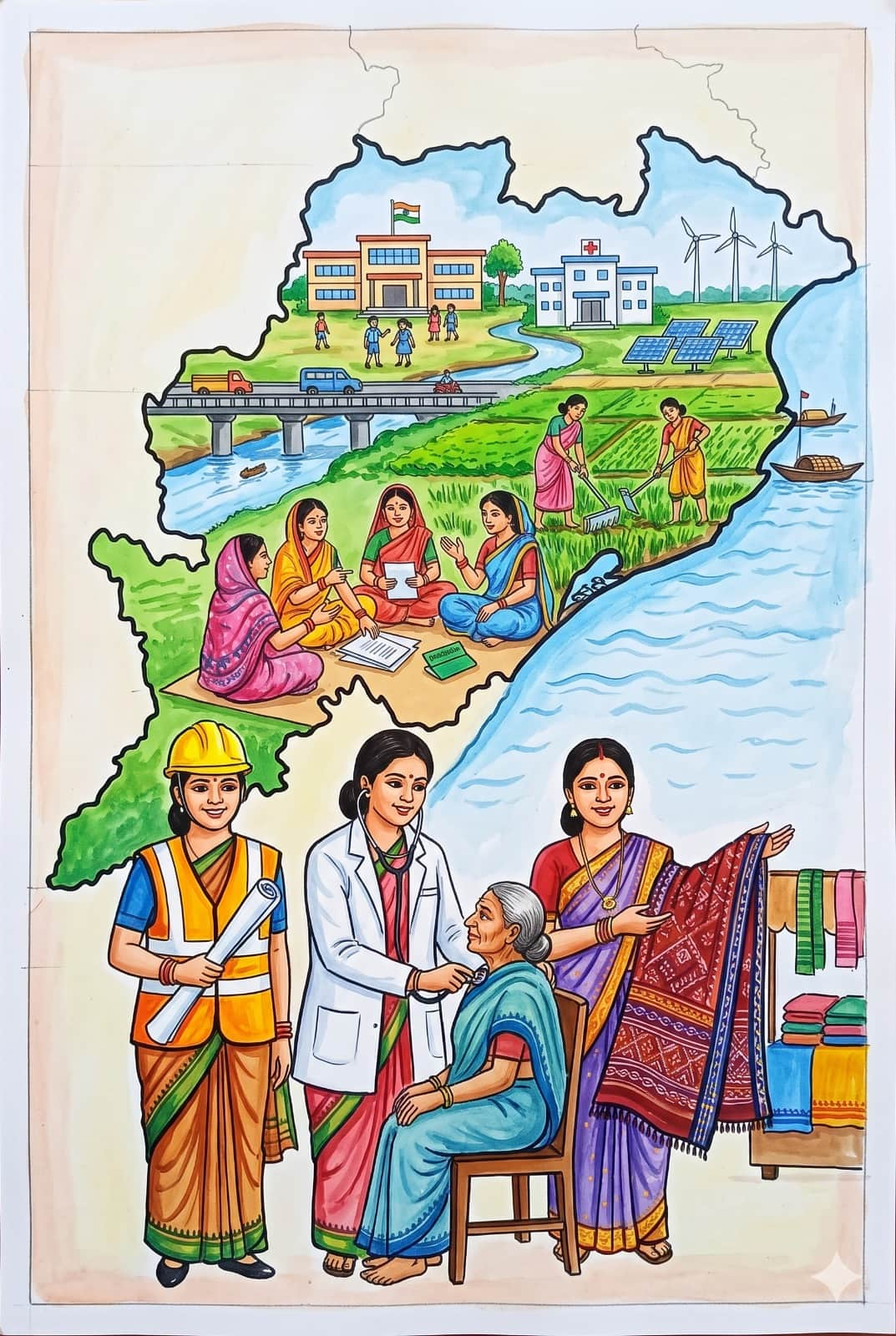
Visual Metaphors:
- The Map Canvas: Framing the land within the border of Odisha immediately roots the vision locally[cite: 3].
- Sustainable Infrastructure (Upper Map): Clean wind power, solar panels, modern school buildings, and accessible healthcare facilities show a balanced model of development[cite: 3].
- Grassroots Movement (Midground): A village Self-Help Group (SHG) seated together with books and registers reflects financial literacy, accompanied by women farmers tending lush paddy fields[cite: 3].
- Coastal Economy (East): The blue Bay of Bengal with local boats represents Odisha’s maritime trade and coastal livelihoods[cite: 3].
- Professional Leadership (Foreground):
- Infrastructure: A female engineer holding rolled blueprints[cite: 3].
- Compassionate Healthcare: A doctor with a stethoscope treating a seated senior citizen[cite: 3].
- Preservation of Heritage & Commerce: An entrepreneur proudly draping a traditional maroon-and-black Sambalpuri Ikat saree[cite: 3].
2. Materials & Color Palette
- Recommended Paper: 200–300 GSM Cartridge or Cold-Pressed Watercolor Sheet (A3 or Half Imperial).
- Medium: Poster Colours, Gouache, and waterproof pigment liners.
- Brushes:
- Flat Brush (No. 8 or 10) for sky, sea, and broad map wash.
- Round Synthetic Brushes (No. 2, 4, 6) for figures and structures.
- Micro Detail Brush (No. 0 or 000) for face outlines and Sambalpuri saree motifs.
- Palette Breakdown:
- Landscape & Inland Map: Sap Green, Light Olive, Cobalt Blue, Lemon Yellow, Terracotta[cite: 3].
- Bay of Bengal: Sky Blue, Cerulean Blue, mixed with slight White waves[cite: 3].
- Skin Tones: Yellow Ochre mixed with a touch of Vermilion and Titanium White; shaded using Burnt Sienna.
- Foreground Fabrics: Safety Orange/Chrome Yellow (Vest), Deep Maroon, Ultramarine, and White (Sambalpuri Bandha weave)[cite: 3].
3. Step-by-Step Drawing Process
Step 1: Mapping and Proportions
- Begin by lightly drawing the organic boundary contour of Odisha across the center and upper two-thirds of your sheet[cite: 3]. Keep the coastal curve smooth and accurate on the right side[cite: 3].
- Leave the bottom 35% of the paper free for the three main foreground figures[cite: 3].
- Block in the three foreground figures:
- Left: The engineer standing tall in 3/4th view with a rolled blueprint[cite: 3].
- Center: The doctor bending slightly forward to examine an elderly woman seated in a wooden chair[cite: 3].
- Right: The handloom entrepreneur spreading out the pallu of an Ikat saree[cite: 3].
Step 2: In-Map Background Details
- In the upper northern sector of the map, sketch the school building (complete with the Tricolour) and the healthcare center[cite: 3].
- Place wind turbines on the top right ridgeline, followed by a grid of blue solar panels[cite: 3].
- Sketch the river cutting across the central plains, crossed by a concrete road bridge carrying transport vehicles[cite: 3].
- Draw the circular meeting of 4–5 women sitting on a mat with notebooks, and beside them, women farmers harvesting the field[cite: 3].
Step 3: Base Washes (Background & Marine Coast)
- The Bay of Bengal: Apply a broad wash of Cerulean Blue blended into White along the coast[cite: 3]. Add light horizontal strokes for waves, placing small wooden boats on the horizon[cite: 3].
- Inland Map Wash: Use fresh Sap Green and Light Olive for fields, light grey for bridge concrete, and soft Cerulean for the inland river[cite: 3].
- Outer Border: Keep the area outside the Odisha map clean or paint a soft, warm cream/peach tint to make the map pop dramatically off the page[cite: 3].
Step 4: Painting Midground Characters & Buildings
- Paint the school in light ochre and the hospital in clean hospital-white and sky blue[cite: 3].
- Paint the solar panels using deep Prussian Blue with white grid lines[cite: 3].
- For the SHG gathering, paint bright, varied sarees—yellow, pink, teal, and saffron—to represent diversity and active village participation[cite: 3].
Step 5: Rendering Foreground Characters
- The Engineer: Base coat the saree in warm ochre[cite: 3]. Add the safety jacket in Chrome Yellow with clear white reflective stripes, topped with a bright yellow safety helmet[cite: 3].
- The Doctor & Patient:
- Paint the doctor’s apron clean white, adding delicate grey folds[cite: 3]. Use a fine liner to render the stethoscope resting around her neck[cite: 3].
- Paint the elderly patient with silver-grey hair tied back in a bun, dressed in a humble sea-green/blue saree[cite: 3].
- The Handloom Entrepreneur:
- Coat her base saree in rich purple and ochre border[cite: 3].
- Carefully render the showcased Sambalpuri saree in classic Maroon/Crimson[cite: 3]. Use a fine No. 0 brush or white gel pen to draw traditional geometric Bandha patterns, fish, or floral motifs along the border and pallu[cite: 3].
Step 6: Final Outlining & Accent Highlights
- Trace the entire Odisha map outline with a bold, dark green or deep charcoal contour line to give it immediate structural strength[cite: 3].
- Outline all human figures using a dark sepia or 0.5 mm waterproof pigment pen[cite: 3].
- Add tiny dots of pure White gouache to eyes, jewelry, stethoscope metal, and the blueprint lines to bring the artwork to life[cite: 3].
4. Key Takeaways for Art Competition Judges
| Assessment Criteria | Why This Composition Succeeds |
|---|---|
| Originality & Framing | Using the geographic map boundary of Odisha avoids repetitive layouts and immediately commands attention[cite: 3]. |
| Comprehensive Scope | Bridges modern high-tech sectors (infrastructure, medicine, green energy) with grassroots rural reality (farming, SHGs, handloom)[cite: 3]. |
| Cultural Resonance | Spotlights traditional Odishan heritage through the Sambalpuri Ikat craft and local geography[cite: 3]. |
| Focal Clarity | Large, detailed foreground figures provide emotional human warmth, while the map behind them delivers the broad thematic message[cite: 3]. |