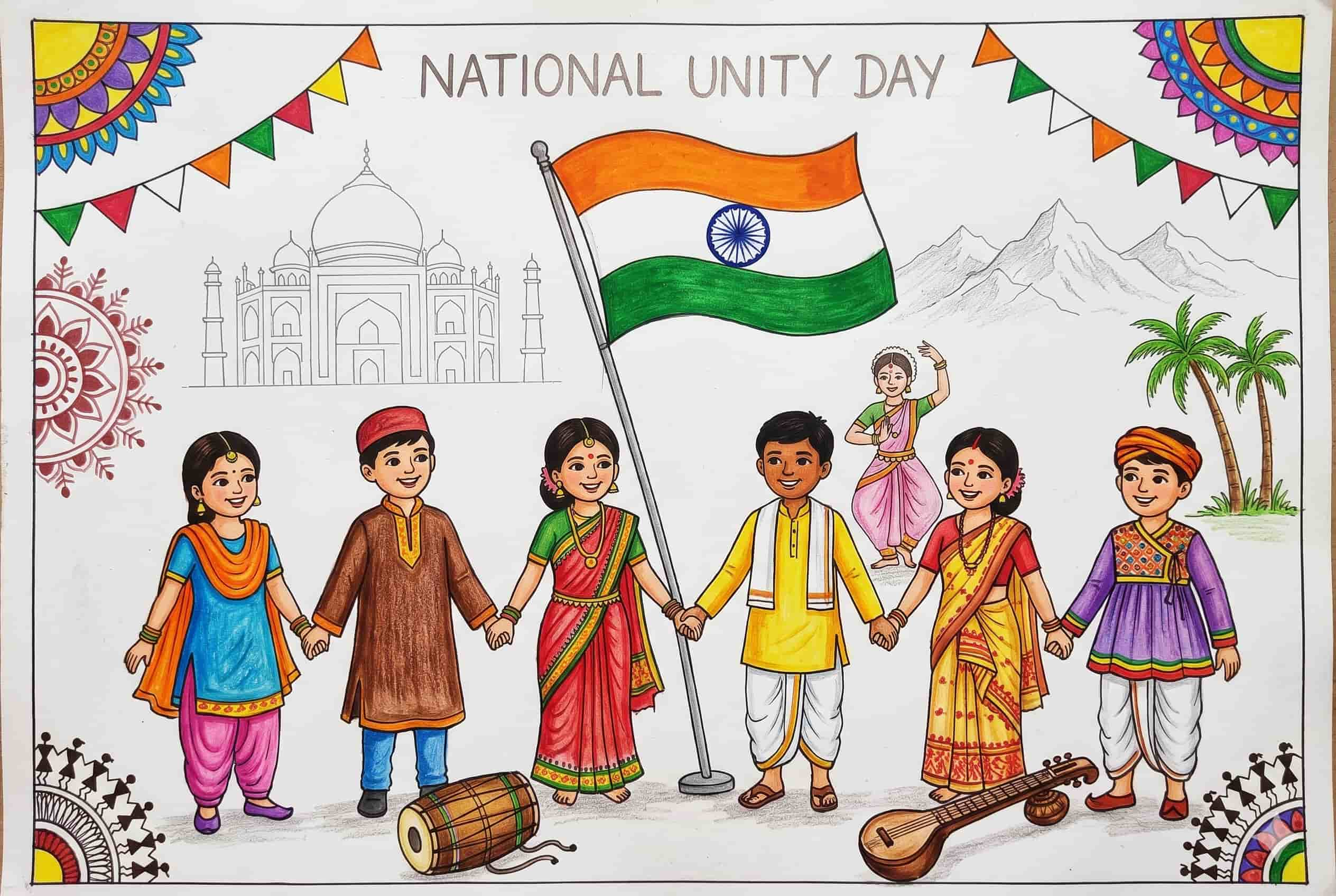
Visual Metaphors and Regional Representation:
- The Central Anchor (The Tricolour): The Indian National Flag flutters prominently in the center, held collectively by the two middle children, demonstrating that patriotism unites the younger generation[cite: 16].
- The Living Human Chain (Six Children):
- Punjab (Far Left): A young girl wearing a bright sky-blue and orange Salwar Kameez with traditional juttis[cite: 16].
- Kashmir (Mid-Left): A young boy wearing an earth-toned embroidered Pheran with a traditional cap[cite: 16].
- South India (Center-Left): A young girl in a red and green temple-bordered Pattu Pavadai with gold ornaments[cite: 16].
- Eastern India / Odisha and Bengal (Center-Right): A boy in a bright mustard-yellow Kurta and white Dhoti with a draped border Uttariya[cite: 16].
- Assam / Northeast (Mid-Right): A girl wearing a traditional Mekhela Sador in cream-yellow adorned with red woven motifs[cite: 16].
- Gujarat / Western India (Far Right): A boy dressed in an embroidered purple Kediyu, pleated white Chorno, and a colourful Kathiawadi turban[cite: 16].
- Performing Arts and Music: A classical dancer positioned in the midground, flanked by an earthen Dholak and a classical Saraswati Veena on the foreground floor plane[cite: 16].
- Geographic Heritage:
- North and Plains represented by line art of the Taj Mahal and Himalayan mountain peaks[cite: 16].
- Coastal belts depicted through slender coconut palms[cite: 16].
- Folk identity anchored by Warli dance stick-figures and intricate corner Mandalas[cite: 16].
2. Materials and Color Palette
- Recommended Paper: 200–300 GSM Heavy Cartridge or Cold-Pressed Watercolor Sheet (A3 Landscape orientation)[cite: 16].
- Medium: Poster colours combined with colored pencils for fabric textures, and fine waterproof archival pens for contouring[cite: 16].
- Brushes and Tools:
- Flat Wash Brush (No. 8 or 10) for broad ground washes[cite: 16].
- Synthetic Round Brushes (No. 2, 4, 6) for painting the children’s outfits and the flag[cite: 16].
- 0.5 mm and 0.8 mm Black Waterproof Pigment Pens for clean linework, lettering, and Warli motifs[cite: 16].
- Palette Breakdown:
- National Tricolour: Deep Saffron, Titanium White, Viridian Green, Navy Blue[cite: 16].
- Costumes: Sky Blue, Mustard Yellow, Scarlet Red, Emerald Green, Royal Purple, and Burnt Sienna[cite: 16].
- Instruments and Palms: Raw Sienna, Burnt Umber, Sap Green, and Chrome Yellow[cite: 16].
- Folk Borders: Pure White, Terracotta Red, and Primary Blue[cite: 16].
3. Step-by-Step Drawing Process
Step 1: Layout and Proportions
- Tape down an A3 landscape paper and rule a neat 1 cm black outer frame[cite: 16].
- Lightly rule pencil lines along the upper center to block out the title text: “NATIONAL UNITY DAY”[cite: 16].
- Draw a ground baseline across the lower third of the paper to anchor the children’s feet[cite: 16].
- Block in the positions of the six children holding hands, maintaining uniform heights and cheerful expressions[cite: 16].
- Place the central flagpole right between the two middle children so that the flag billows across the upper open sky[cite: 16].
Step 2: Background Landmarks and Buntings
- Across the upper corners, sketch colourful triangular bunting festoons to give the artwork a celebratory atmosphere[cite: 16].
- In the upper-left negative space, sketch the architectural contour of the Taj Mahal using light pencil lines[cite: 16]. Keep this delicate as line art so it recedes into the background[cite: 16].
- On the upper-right, sketch the jagged ridges of the Himalayas and two slender coconut palms on a small grassy mound[cite: 16].
- Sketch the small classical dancer between the flagpole and the eastern region girl[cite: 16].
Step 3: Base Washes and Flag Rendering
- The Tricolour: Paint the top stripe in Deep Saffron and the bottom stripe in crisp Green[cite: 16]. Leave the middle band white, and paint the 24-spoked Ashoka Chakra using Navy Blue with a fine detail brush[cite: 16]. Paint the flag mast in cool metallic grey[cite: 16].
- Ground Plane: Lay down a very light, warm grey and beige wash along the bottom plane to ground the characters without making the bottom look dark[cite: 16].
- Buntings: Fill the triangular flags with alternating shades of Saffron, Leaf Green, Red, and Yellow[cite: 16].
Step 4: Coloring Costumes and Skin Tones
- Skin Tones: Apply a glowing base tone using Yellow Ochre, a touch of Vermilion, and White[cite: 16]. Shade contours under chins and around cheeks with a light glaze of Burnt Sienna[cite: 16].
- Costume Detailing:
- Punjab: Bright Cyan/Blue tunic with warm Orange borders and pink salwar[cite: 16].
- Kashmir: Earthy brown-grey Pheran with yellow embroidered neckline and cuffs[cite: 16].
- South India: Vibrant Red saree draped with an Emerald Green blouse and gold temple border lines[cite: 16].
- Odisha / Bengal: Warm Lemon/Mustard yellow kurta with a crisp white pleated dhoti[cite: 16].
- Assam: Golden-yellow Mekhela Sador with red woven floral patterns[cite: 16].
- Gujarat: Violet/Purple flared kediyu with multicoloured geometric embroidery on the chest yoke and an orange Kathiawadi pagri[cite: 16].
Step 5: Musical Instruments and Folk Borders
- Instruments:
- On the left ground, paint the Dholak in warm wood tones (Burnt Sienna/Umber) with bright yellow binding rings[cite: 16].
- On the right ground, render the Veena with polished mahogany shades, white bridge accents, and fine golden string lines[cite: 16].
- Corner Motifs:
- Paint the top circular Mandalas with bright festive concentric rings[cite: 16].
- In the bottom corners, sketch black-and-white Warli dancing figures holding hands, echoing the unity motif of the main characters[cite: 16].
Step 6: Contours, Ink Outlining, and Final Highlights
- Inking: Trace all human figures, clothing folds, eyes, and fingers cleanly using a 0.5 mm black waterproof fineliner to give the composition a crisp illustrative finish[cite: 16].
- Lettering: Trace the header “NATIONAL UNITY DAY” in bold, clean block letters[cite: 16].
- Highlights: Use an opaque white gel pen or fine white gouache to add highlights on jewelry, eyes, fabric embroidery, and flag folds to make the artwork pop[cite: 16].
4. Key Takeaways for Art Competition Judges
| Assessment Factor | How This Artwork Succeeds |
|---|---|
| Thematic Authenticity | Perfectly embodies Ek Bharat Shreshtha Bharat by visually celebrating diverse regions through authentic clothing, instruments, and landmarks[cite: 16]. |
| Compositional Harmony | The horizontal human chain creates a strong, continuous visual flow, while the central flag and dancer provide vertical balance[cite: 16]. |
| Student-Friendly Execution | The clear, distinct character outlines and structured flat-coloring approach make it manageable within standard 2-hour competition constraints[cite: 10, 16]. |
| Cultural Depth | Incorporating folk art borders (Warli, Mandalas) alongside classical instruments (Veena, Dholak) adds immense artistic value[cite: 16]. |