Visual Metaphors:
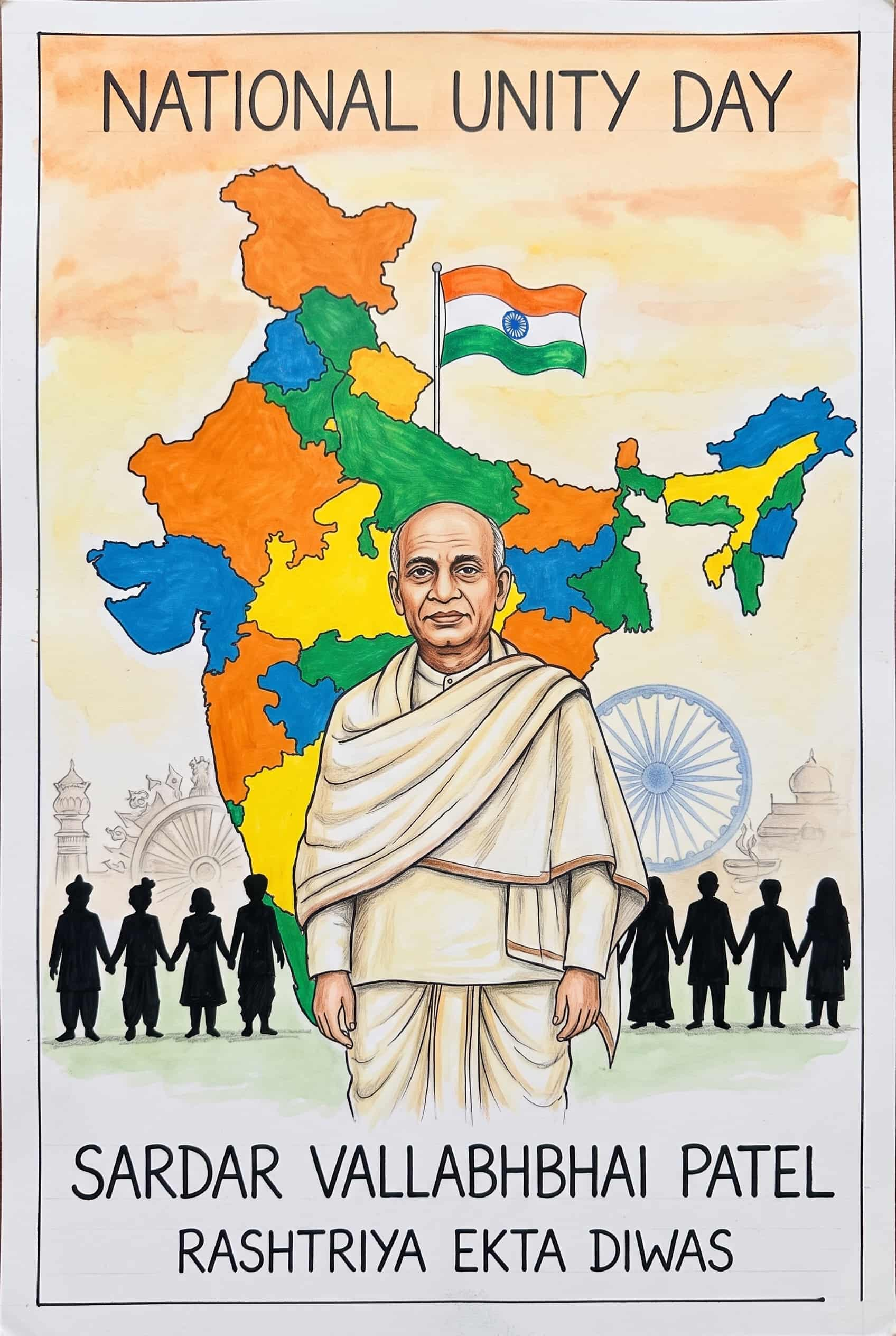
- The Interlocking Map: Instead of routine political boundaries, depicting the subcontinent as interlocking puzzle pieces highlights Sardar Patel’s role in negotiating the merger of over 560 separate princely states into one united nation[cite: 14, 15].
- The Central Anchor (Sardar Patel): Positioned firmly in the center foreground, his draped off-white khadi shawl and upright posture symbolize statesmanship, resolve, and steadfast governance[cite: 14, 15].
- The People’s Chain (Silhouettes): Stark black silhouettes of citizens in traditional attire (turbans, safas, dhotis, and sarees) clasping hands emphasize grassroots integration—Ek Bharat, Shreshtha Bharat[cite: 14, 15].
- Background Heritage Accents: Soft, line-drawn depictions of the Ashoka Chakra, temple spires, and historic monuments add architectural texture without overpowering the main subject[cite: 14, 15].
2. Materials & Color Palette
- Recommended Paper: 200–300 GSM Cartridge or Cold-Pressed Watercolor Sheet (A3 Portrait format)[cite: 14, 15].
- Medium: Poster colours combined with fine waterproof pigment liners and colored pencils[cite: 14, 15].
- Brushes & Tools:
- Flat Wash Brush (No. 8 or 10) for the upper sky gradient[cite: 14].
- Synthetic Round Brushes (No. 2, 4, 6) for painting the jigsaw pieces and fabric shading[cite: 14].
- 0.5 mm & 0.8 mm Black Waterproof Fineliners for lettering, facial lines, and state puzzle outlines[cite: 14].
- Color Palette:
- Sky: Pale Lemon Yellow blended upwards into soft Peach/Warm Apricot[cite: 14, 15].
- Puzzle Map: Deep Saffron, Chrome Yellow, Sap Green, and Cobalt/Prussian Blue[cite: 14, 15].
- Khadi Attire: White base shaded with Warm Grey, Pale Umber, and light Ochre fold shadows[cite: 14, 15].
- Skin Tones: Yellow Ochre mixed with Scarlet and White, shaded with Burnt Sienna[cite: 14, 15].
3. Step-by-Step Drawing Process
Step 1: Layout & Symmetry Guidelines
- Draw a 1 cm margin around all four edges of the A3 sheet[cite: 14, 15].
- Reserve 4 cm at the top for “NATIONAL UNITY DAY” and 5 cm at the bottom for “SARDAR VALLABHBHAI PATEL / RASHTRIYA EKTA DIWAS”[cite: 14, 15].
- Draw a light vertical center line to align the head and torso of Sardar Patel[cite: 14].
- Block in the India map directly behind the figure[cite: 14, 15]. Divide the map into distinct interlocking puzzle shapes with tab-and-blank edges rather than standard administrative borders[cite: 14, 15].
Step 2: Lettering & Background Tones
- Lightly rule pencil lines for the top and bottom text, keeping letters uniform, tall, and legible[cite: 14, 15]. Ink them cleanly using a black felt pen[cite: 14, 15].
- Apply a transparent wet-on-dry gradient across the sky: lay Lemon Yellow around the map contour and blend outward into soft Peach[cite: 14, 15].
- In the empty midground flanks, use a light grey pencil or thin liner to sketch the outlines of the Ashoka Chakra and heritage spires[cite: 14, 15]. Keep these faint to maintain high visual contrast[cite: 14].
Step 3: Painting the Jigsaw Map & Flag
- Paint the puzzle tiles in clean, opaque primary shades: Deep Saffron, Lemon Yellow, Sap Green, and Prussian Blue[cite: 14, 15]. Ensure adjacent puzzle pieces have contrasting colors[cite: 15].
- Render the Tricolour above the northern border: Saffron at the top, White in the center with a circular 24-spoke navy-blue Ashoka Chakra, and Green at the bottom[cite: 14, 15].
- Trace every jigsaw seam with a sharp 0.5 mm black liner to make the puzzle metaphor pop[cite: 14, 15].
Step 4: Sardar Patel’s Portrait
- Skin Tone: Apply a base of Yellow Ochre tinted with a drop of Scarlet and White[cite: 14, 15]. Layer Burnt Sienna along cheekbones, laugh lines, and the brow to capture his resolute expression[cite: 14, 15]. Leave hair white/grey along the temples[cite: 14, 15].
- Khadi Shawl & Kurta:
- Paint the garments in an off-white base[cite: 14, 15].
- Define the thick, natural folds of the wrapped shawl using directional strokes of Raw Umber and Warm Grey[cite: 14, 15].
- Run a delicate brown-ochre decorative border along the shawl’s edge[cite: 14, 15].
Step 5: Grounding Silhouettes & Human Chain
- Paint the grass base along Patel’s waist in light olive green[cite: 14, 15].
- Paint the chain of citizens holding hands in solid Lamp Black/Charcoal[cite: 14, 15].
- Include clear regional headgear silhouettes (Rajasthani pagri, Pahadi cap, South Indian angavastram, Odia/Bengali saree pallu) to represent all corners of the country united together[cite: 14, 15].
Step 6: Final Line Work and Highlights
- Cleanly outline Sardar Patel’s silhouette, hands, eyes, and shawl folds with a 0.3 mm or 0.5 mm pigment pen[cite: 14, 15].
- Add tiny white gouache points on the eyes, flag pole highlights, and puzzle highlights to lift the composition off the paper[cite: 14].
- Erase stray guidelines across the white border margins[cite: 14].
4. Key Takeaways for Art Competition Judges
| Assessment Factor | How This Poster Succeeds |
|---|---|
| Concept Execution | The jigsaw puzzle map translates historical policy into a clear visual narrative within seconds[cite: 14, 15]. |
| Portrait Balance | Sardar Patel’s central placement commands attention while leaving the national symbols legible behind him[cite: 14, 15]. |
| Time Management | The design achieves maximum graphic contrast through silhouettes and block coloring, easily executable within a 2-hour competition window[cite: 10, 14, 15]. |
| Typography & Finish | Dedicated top and bottom text zones make the poster competition-ready without encroaching on the art[cite: 14, 15]. |