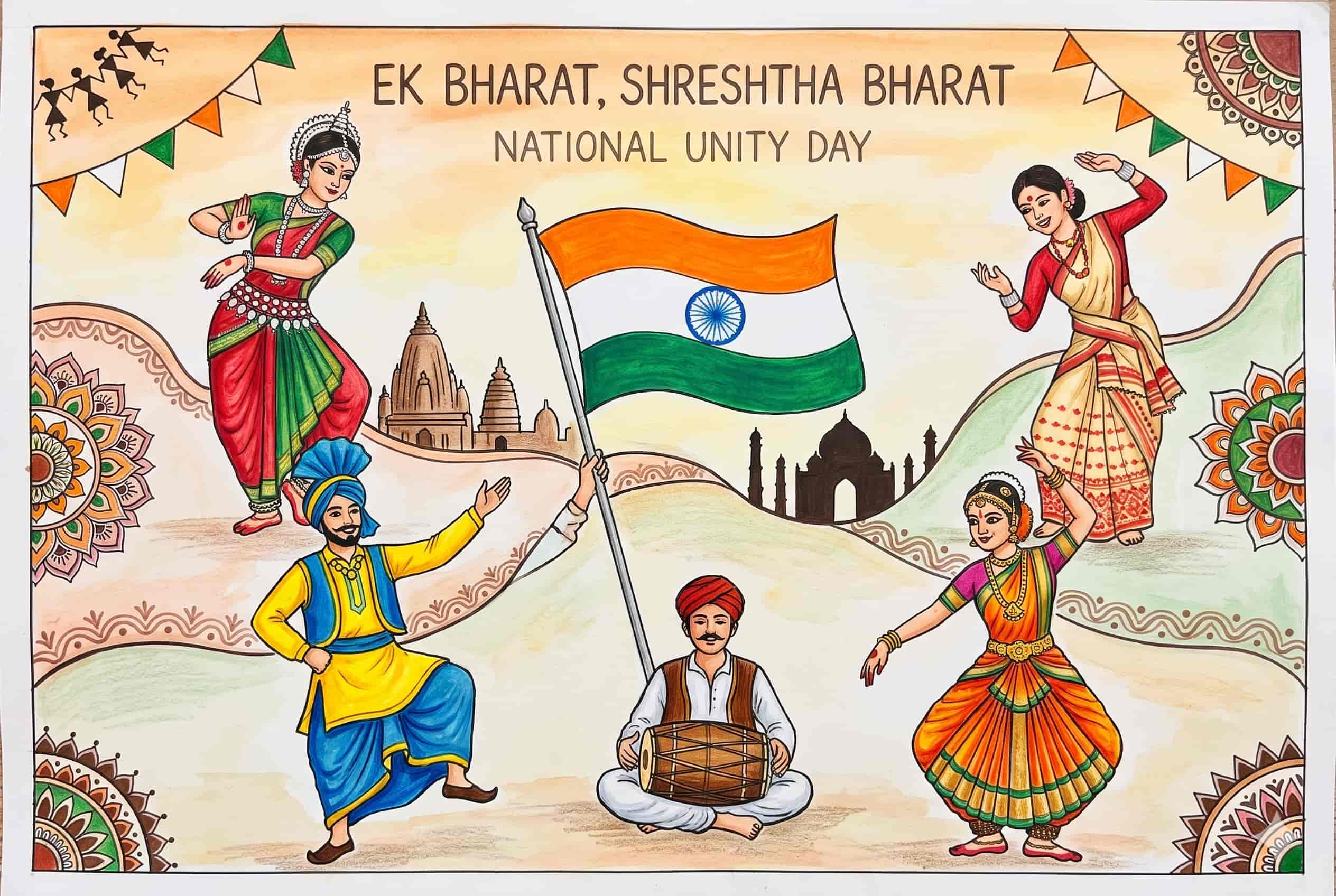
Visual Metaphors & Cultural Pillars:
- The Living Core (Four Corners of Dance):
- East (Odissi): Posed in the classical Tribhangi posture on the upper left, wearing traditional silver filigree jewelry (Tarakasi), a red-and-green costume, and the signature white flower headdress (Tahia)[cite: 21].
- North (Bhangra): An energetic male performer on the lower left leaping with arms raised, dressed in a vibrant yellow kurta, blue lungi/chadra, and matching flared turla turban[cite: 21].
- Northeast (Assamese Bihu): A female dancer in the upper right draped in a traditional off-white and red woven Mekhela Sador, hands positioned in the signature rhythmic Bihu mudra[cite: 21].
- South (Bharatanatyam): Positioned on the lower right in a balanced Aramandi half-seated posture, dressed in pleated saffron-and-green silk with temple jewelry and floral gajra[cite: 21].
- The Rhythmic Center (Folk Musician & Flag): Seated cross-legged in the center foreground, a folk drummer wearing a red turban plays a traditional Dholak, providing the beat that binds all four regional dances into unison[cite: 21]. Directly behind him, the Indian Tricolour waves prominently on a tall mast held firmly by one of the performers[cite: 21].
- Architectural Dialogue: Soft monochromatic line sketches of historic Indian monuments—an ancient stone temple shikhara on the left and the Mughal domes and minarets of the Taj Mahal on the right—ground the artwork in classical history[cite: 21].
- Folk Flourishes: Bordered by festive paper buntings, corner mandalas, flowing wave ribbons, and miniature Warli stick figures holding hands, illustrating unity across classical, tribal, and folk traditions[cite: 21].
2. Materials & Color Palette
- Paper: 200–300 GSM Heavy Cartridge or Cold-Pressed Watercolor Sheet (A3 Landscape)[cite: 21].
- Medium: Poster colours combined with soft colored pencils for gradients, and waterproof pigment liners for ink outlines[cite: 21].
- Brushes & Tools:
- Flat Wash Brush (No. 8 or 10) for the smooth sky and landscape bands[cite: 21].
- Round Synthetic Brushes (No. 2, 4, 6) for painting dancer costumes and instruments[cite: 21].
- 0.5 mm & 0.8 mm Black Waterproof Fine Liners for lettering and borders[cite: 21].
- Palette Breakdown:
- The National Tricolour: Deep Saffron, Titanium White, Viridian Green, Navy Blue[cite: 21].
- Costumes: Primary Yellow, Ultramarine Blue, Crimson Red, Bottle Green, Ochre, and Purple[cite: 21].
- Architecture & Background: Raw Sienna, Burnt Umber, Light Peach, and Soft Cream[cite: 21].
- Folk Accents: Pure White gouache, Warm Terracotta, and Chrome Yellow[cite: 21].
3. Step-by-Step Drawing Process
Step 1: Layout & Symmetry Guidelines
- Tape the borders cleanly and draw a 1 cm margin around the sheet[cite: 21].
- Rule light pencil lines along the top center for the dual title: “EK BHARAT, SHRESHTHA BHARAT” and “NATIONAL UNITY DAY”[cite: 21].
- Sketch a central diagonal line across the middle third to establish the flagpole, placing the fluttering flag in the upper-middle canvas[cite: 21].
- Block in the five human figures using simple proportion mannequins:
- Upper-left and upper-right for the Odissi and Bihu dancers[cite: 21].
- Lower-left and lower-right for the Bhangra and Bharatanatyam performers[cite: 21].
- Lower-center for the seated folk drummer[cite: 21].
Step 2: Architecture & Decorative Borders
- In the upper-left corner, draw three dancing Warli stick figures connected by festoon ropes[cite: 21].
- Add circular mandalas with radiating petals in all four corners to frame the landscape[cite: 21].
- In the midground space between the figures, sketch the stone temple spires on the left and the Taj Mahal silhouette on the right[cite: 21].
- Draw fluid, wave-like ground ribbons winding between the figures to separate the foreground stage from the background horizon[cite: 21].
Step 3: Base Sky Wash & The Indian Tricolour
- Atmospheric Sky: Apply a light, warm wash of Pale Peach and Cream across the background sky, leaving the monument areas crisp[cite: 21].
- The Flag: Lay down bold, opaque strokes of Deep Saffron on top and Viridian Green on the bottom[cite: 21]. Keep the central band pure white, adding the 24 spokes of the navy-blue Ashoka Chakra using a fine 00 round brush or 0.3 mm pen[cite: 21].
- Monuments: Paint the temple and Taj Mahal using thin Raw Sienna and Burnt Umber linework with light watercolor washes to keep them in atmospheric perspective[cite: 21].
Step 4: Painting the Dancers & Musician
- Skin Tones: Mix Yellow Ochre with a touch of Vermilion and Titanium White for smooth base skin tones, adding soft Burnt Sienna glazes for shadows under arms and jaws[cite: 21].
- Odissi Dancer (Upper Left): Paint the pleated front fan and blouse in rich Crimson Red and Emerald Green, detailing the silver ornaments with opaque white and grey dots[cite: 21].
- Bhangra Performer (Lower Left): Use vibrant Lemon Yellow for the kurta and bright Cerulean/Ultramarine Blue for the lungi and turban[cite: 21].
- Bihu Dancer (Upper Right): Apply an off-white/cream base for the Mekhela Sador, picking out the red woven border patterns with delicate crimson strokes[cite: 21].
- Bharatanatyam Dancer (Lower Right): Paint the pleated costume fan in radiating bands of Chrome Yellow, Orange, and Green, finishing her hair bun with white gajra flowers[cite: 21].
- Folk Drummer (Center): Paint the wooden dholak in warm Burnt Umber with light grey lace ropes, dressing the musician in a simple white dhoti-kurta, brown vest, and bright red turban[cite: 21].
Step 5: Contours, Lettering, and Final Flourishes
- Ink Outlines: Trace all dancers, facial features, fingers, drapery folds, and instruments with a sharp 0.5 mm black waterproof liner[cite: 21].
- Typography: Carefully ink the top headings using bold, clean architectural block letters[cite: 21].
- Highlights: Use an opaque white gel pen or white gouache to add shine to jewelry, eyes, instrument rims, and the flowing white decorative waves[cite: 21].
4. Key Takeaways for Art Competition Judges
| Evaluation Factor | How This Artwork Delivers |
|---|---|
| Theme Alignment | Visually manifests the motto of Ek Bharat, Shreshtha Bharat through geographic representation of northern, eastern, southern, and northeastern cultural traditions[cite: 21]. |
| Circular Visual Flow | The dynamic movement of the four dancers leads the judge’s eye in a continuous spiral inward toward the central flag and drummer[cite: 21]. |
| Balance of Detail & Space | Concentrates high-detail rendering on the figures while keeping the background monuments soft, avoiding a cluttered look[cite: 21]. |
| Student-Achievable Polish | Combines clean poster color washes with precise line work, making it realistic to finish within a standard 2-hour school competition limit[cite: 10, 21]. |