Visual Metaphors Used:
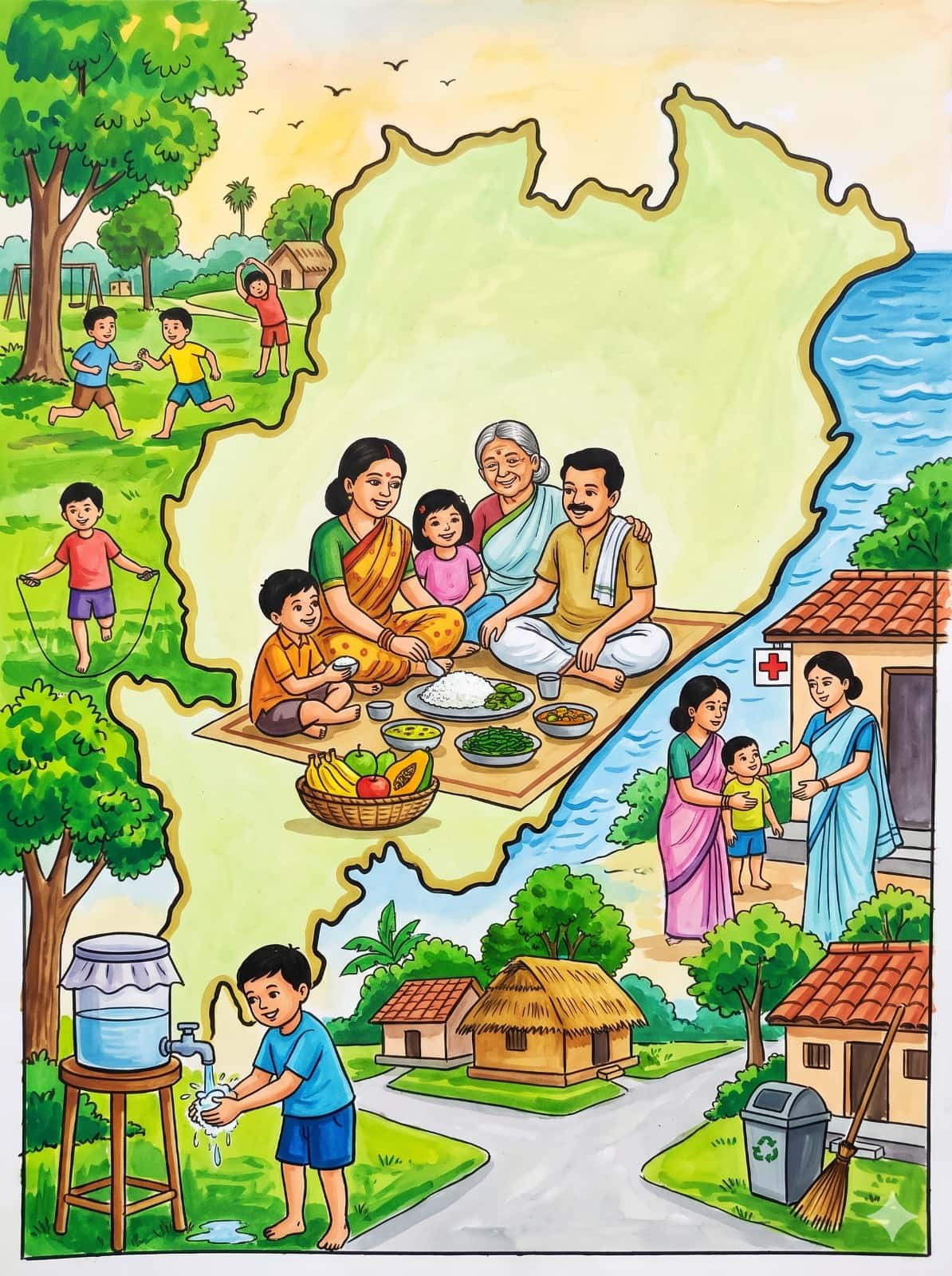
- The State Map Canvas (Center): The geographic outline of Odisha anchors the theme directly to the state’s public health mission[cite: 6].
- Nutrition at the Core (Inside the Map): A multi-generational Odia family sits together on a traditional mat enjoying a wholesome balanced meal served on steel thalis and katoris, complemented by a basket loaded with local seasonal fruits[cite: 6].
- Active Lifestyle (Top & Mid-Left): Kids playing outdoors, skipping rope, and exercising reinforce preventive health and active childhood routines[cite: 6].
- Hygiene & Disease Prevention (Bottom Left): A child washing his hands with running water from a hygienic storage dispenser highlights handwashing practices[cite: 6].
- Community Healthcare (Mid-Right): A village health worker (ASHA / ANM) welcoming a mother and toddler outside a Primary Health Centre or Anganwadi hub emphasizes regular checkups and immunization[cite: 6].
- Clean Village Environment (Bottom Right): Concrete village lanes, a covered waste bin with the recycling symbol, and a broom resting against the wall demonstrate the link between environmental cleanliness and personal health[cite: 6].
2. Recommended Materials & Color Palette
- Paper: 200–300 GSM Cartridge or Cold-Pressed Watercolor Sheet (A3 or Half Imperial size)[cite: 6].
- Medium: Poster colours combined with fine waterproof pigment liners and white gouache[cite: 6].
- Brushes:
- Flat wash brush (No. 8 or 10) for sky, sea, and broad map wash[cite: 6].
- Round synthetic brushes (No. 2, 4, 6) for figures, buildings, and food items[cite: 6].
- Detail brush (No. 0 or 00) for eyes, facial expressions, and fine texturing[cite: 6].
- Color Palette:
- Landscape & Nature: Sap Green, Light Olive Green, Lemon Yellow, and Cerulean Blue[cite: 6].
- Map Background: Soft wash of Pale Lemon Yellow and Tinted Green[cite: 6].
- Coastal Waters (Bay of Bengal): Sky Blue, Cobalt Blue, and Titanium White waves[cite: 6].
- Flesh Tones: Yellow Ochre mixed with Scarlet and White; shaded softly with Burnt Sienna[cite: 6].
- Fresh Food & Fruits: Chrome Yellow, Vermilion, Leaf Green, and Burnt Umber[cite: 6].
3. Step-by-Step Drawing Process
Step 1: Structural Grid & Sketching
- Lightly draw the boundary contour of the Odisha map occupying the central and upper-right region of the paper using a 2B pencil[cite: 6]. Keep the coastal curve clear on the right edge[cite: 6].
- Inside the map boundaries, sketch the central family: the grandmother in the center, flanked by the mother, father, daughter, and young son seated around a dining spread[cite: 6]. Add the fruit basket in front[cite: 6].
- Along the left border, sketch the play area: trees, a boy skipping rope, and children running near a park swing[cite: 6].
- In the lower-left section, draw the wooden stool, clean water vessel with a tap, and a boy washing his hands[cite: 6].
- In the lower-right area, draw the health clinic building with a red cross symbol, the health worker in an apron/saree, and a mother with her child[cite: 6]. Finish the bottom lane with small rural houses and a covered dustbin[cite: 6].
Step 2: Base Washes (Landscape & Coastline)
- Bay of Bengal Coast: Paint the water along the eastern boundary using a clean wash of Cerulean Blue blended into White strokes to indicate gentle coastal waves[cite: 6].
- Inland Landscape: Apply a fresh wash of Pale Green and Lemon Yellow across the village meadows on the left[cite: 6].
- Map Interior Wash: Apply a light, diluted wash of Pale Yellowish-Green inside the Odisha map outline, keeping the area behind the central family soft so they stand out crisply[cite: 6].
Step 3: Painting the Central Nutrition Scene
- Skin Tones: Apply a warm base tone using Yellow Ochre mixed with a touch of Scarlet and White[cite: 6]. Shade the facial contours, arms, and necks with light glazes of Burnt Sienna[cite: 6].
- Clothing:
- Dress the mother in a traditional mustard-and-green saree[cite: 6].
- Paint the father in a simple kurta-dhoti with a gamucha draped on his shoulder[cite: 6].
- Dress the children in bright modern clothes (pink and yellow shirts)[cite: 6].
- Paint the grandmother’s hair in soft silver-grey and dress her in a simple pale blue-bordered saree[cite: 6].
- Food & Nutrition Spread:
- Paint the white rice mound on the central platter, surrounded by dark green spinach/saag, golden-yellow dal, and seasonal vegetable curry in bowls[cite: 6].
- Paint the fruit basket: bright yellow bananas, a sliced orange papaya, and a crisp red apple[cite: 6].
Step 4: Rendering Hygiene and Healthcare Areas
- Handwashing Station (Lower Left):
- Paint the clear water jar with light Sky Blue, leaving crisp white paper highlights for transparency[cite: 6].
- Paint the boy in a blue t-shirt and shorts, detailing the white soap suds foaming between his hands[cite: 6].
- Paint the wooden stool using Burnt Sienna with linear wood grain strokes[cite: 6].
- Community Clinic & ASHA Worker (Mid-Right):
- Base coat the clinic walls in pale cream and paint the red cross on the signboard[cite: 6].
- Paint the health worker’s light blue saree and dark blue border, showing her interacting gently with the child and mother[cite: 6].
Step 5: Village Surroundings & Sanitation (Foreground Bottom)
- Paint the village rooftops in Terracotta Red and Raw Sienna thatch texture[cite: 6].
- Render the paved grey lane winding past the houses[cite: 6].
- Paint the green/grey covered recycling bin and the traditional grass broom resting beside the doorstep, highlighting clean village habits[cite: 6].
Step 6: Contours, Outlines, and Final Details
- Map Outline: Trace the entire Odisha border with a defined olive-green or dark sepia line to make the state map silhouette immediately readable from a distance[cite: 6].
- Character Outlining: Trace the figures, eyes, expressions, and clothing folds with a 0.3 mm or 0.5 mm waterproof black pen[cite: 6].
- Highlights: Use opaque white gouache to add highlights on the water splash, soap bubbles, glossy fruits, and metallic dinnerware[cite: 6].
4. Key Takeaways for Art Competition Judges
| Assessment Factor | How This Artwork Delivers |
|---|---|
| Comprehensive Theme Coverage | Unites all three required pillars—Health (exercise & clinics), Safety (sanitation & hygiene), and Nutrition (balanced traditional diet)[cite: 6]. |
| Framing & Regional Relevance | The geographic Odisha map frame instantly personalizes the message to state-level welfare programs[cite: 6]. |
| Visual Storytelling | Creates distinct lifestyle zones without visual clutter, guiding the viewer’s eye naturally from active play down to clean sanitation[cite: 6]. |
| Positive Emotional Tone | The warm, smiling family and encouraging health worker provide an uplifting, aspirational perspective on public health[cite: 6]. |