Respected judges, honourable teachers, worthy opponents, and my dear friends, a very good morning to all.
Imagine a family that cannot afford two square meals a day. Imagine a child who walks miles on muddy tracks to reach school because there is no paved road.
[Pause]
For them, what must come first: protecting wildlife habitats, or securing the basic dignity of human life?
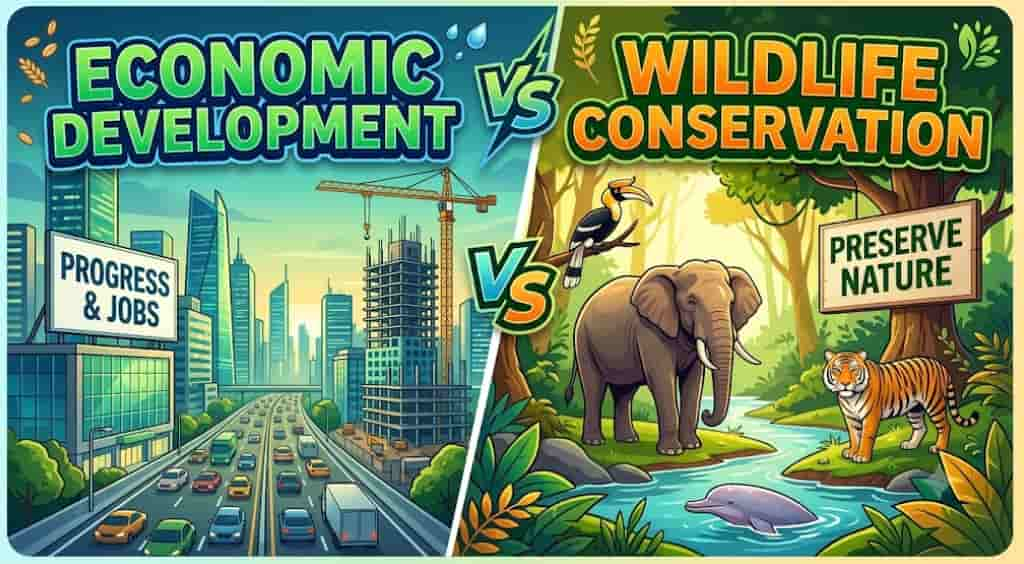
I stand firmly for the motion that economic development must take priority over wildlife conservation.
First, poverty alleviation is a moral imperative. Human beings need food, clean water, healthcare, and employment to survive. Economic growth builds industries, generates jobs, and lifts families out of extreme poverty. We cannot ask a community fighting for daily survival on empty stomachs to prioritise conservation over bread.
Second, development builds life-saving infrastructure. Paved roads connect remote villages to emergency hospitals. Electricity powers schools, cold storages, and local enterprise. When we delay critical railways, highways, or power grids, we delay the basic rights of rural citizens.
Third, economic prosperity actually funds conservation. It takes capital to deploy anti-poaching patrols, build wildlife corridors, fund satellite tracking, and compensate farmers for man-animal conflict losses. A poor nation cannot afford modern wildlife sanctuaries; a wealthy economy can.
My worthy opponents will argue that development destroys ecosystems. I concede that reckless exploitation is harmful. But the answer to bad development is not zero development—the answer is smart, sustainable progress.
[Emphasize with confidence]
Human welfare cannot be held hostage in the name of conservation.
Wildlife certainly deserves our care, but human beings deserve a future of dignity and opportunity. Let us build an economy strong enough so that it has the power to uplift human lives and protect the planet.
Thank you.
Speech: Against the Motion (Opposition)
Respected judges, honourable teachers, worthy opponents, and my dear friends, a very good morning to all.
Imagine waking up one morning to find that the perennial river supplying drinking water to your town has dried up, crops have withered in barren fields, and the dense forests that once shielded your community have turned into dust.
[Pause]
In such a world, would flyovers, skyscrapers, and industrial balance sheets still look like success?
I stand firmly against the motion. Wildlife conservation is not an obstacle to human progress; it is the very foundation upon which any lasting economy stands.
First, ecological collapse directly threatens human survival. Forests, wetlands, rivers, and wildlife do not exist in isolation—they form a living life-support system. When we bulldoze forests for quick industrial gains, we disrupt rainfall cycles, invite flash floods, and accelerate soil erosion. Concrete cannot replace topsoil, and money cannot manufacture drinking water.
Second, extinction is permanent and irreversible. Once a species is wiped off the face of the Earth, no technology, no global grant, and no treasury in the world can buy it back. Every pollinator, bird, and apex predator performs an irreplaceable role in keeping our ecosystems stable. When bees and insects vanish, agriculture collapses—and with it, our food security.
Third, nature provides silent, multi-trillion-dollar economic services every single day for free. Mangroves protect coasts from cyclones, wetlands filter toxic runoff, and dense forest canopies regulate regional climates. These are not luxuries; they are essential economic safety nets.
[Emphasize with conviction]
Without a functioning biosphere, there can be no agriculture, no factories, and no economy.
My worthy opponents claim that rapid economic growth provides the wealth needed to fund conservation later. But can wealth bring back an extinct rhino? Can high GDP numbers restore poisoned groundwater or reverse desertification?
[Pause]
The answer is an unequivocal no. You cannot burn down the foundation of the house to buy luxurious furniture for the living room.
I am not opposed to human upliftment. I stand for true, sustainable progress—development that respects planetary boundaries.
To conclude, an economy can always bounce back from financial recessions, but an ecosystem cannot recover from irreversible destruction. Real progress does not mean plundering the living earth; it means securing a future where both human potential and the natural world thrive together.
Thank you.